

Adriana Zoudine
Next event :
One-man show
Arianna Sartori Gallery
February 14th to 26th, 2026


recent exhibitions
2026 The Rio

The Rio:
The ethereal element: the quintessential artistry of the Rio of Mantua
Adriana Zoudine
I see the canal, by turns, revealing and concealing of itself; in the brief moments it opens up, the Rio offers me rare insights to secret away and furtively draw upon.
As I lean over the arched walls and railings of our Rio's gardens, absorbed in the flow of its waters — sometimes choppy; occasionally calm; often resplendent — I study its reverberations, given pause to the river of time.
The canal images I’m able to glimpse in and along its meanderings are reflected bridges, ancient buildings, and the sky, revealing deconstructed, ever-changing scenarios.
Amid the thrill of these encounters is the attempt to capture the mirroring for later sharing with others. I have an improbable challenge that lies in the desire to represent them.
I immerse myself in the playful patterns mirrored in the Rio, and with my imagination I compose distorted shapes to create abstract paintings.
Adriana Zoudine transforms water and light into visual memory, the poetic cipher to her artistic quest
Serenella Minto
The incessant transformation of the visible
In Zoudine, attention is not so much focused on the subject represented—the waterway flowing through Mantua—as on the atmosphere that envelops and transforms it. Light becomes the true object of the representation, a dynamic principle that determines perception and makes visible the incessant metamorphosis of reality.
The series dedicated to the Rio di Mantua, shot from different angles and at different times of day, emerges as a unified conceptual corpus: the central theme is not the Rio's water, but rather time and memory, understood as an awareness of the inexhaustible flow of reality.
For the artist, therefore, it is not a matter of capturing unrepeatable moments of reality, but, on the contrary, of demonstrating how there is no such thing as a single moment, but rather a continuous evolution of phenomena in which human presence is not even considered: everything evolves even without our witness.
Yet, beyond critical reflection, there is poetic inspiration: every reflection, every vibration of light becomes a silent song, testimony to an unrepeatable moment. The work thus becomes a meditation on light and time, on the fragility of the visible and its constant rebirth. In this interweaving of rigor and lyricism, Zoudine invites us to contemplate not just a landscape, but the eternal transformation of life itself.

From retinal to mental vision
In Adriana Zoudine's works, the landscape is never a faithful representation, but a celebrated perceptual experience. The artist observes the Rio of Mantua — the waterway that flows through the city — as a natural optical device, a place where the substance of the water breaks down reality and regenerates it in the form of rhythm, light, and memory.
Her attention to the Rio's reflections, to what appears and immediately transforms itself, places herself in a tradition that spans the history of art: from the luminous vibrations of the Impressionists to the atmospheric rarefactions of Whistler, to the dissolutions of J. M. W. Turner, where the visible opens up to the realm of emotion.
Zoudine's work, however, is neither quotation nor derivation. For her, water is not a simple mirror, but a living surface that shatters the image into chromatic cells, into fragments that recall maps, textures, and liquid architecture.
The Rio

During the night, 2025
oil on canvas, 100×80 cm

Intersection under the bridge, 2025
oil on canvas, 90×110 cm

Dusk descends upon the town, 2025
oil on canvas, 50×90 cm

Towards evening, 2025
oil on canvas, 50×80 cm

Since forever, 2025
oil on canvas, 70×40 cm

Adrift, 2025
oil on canvas, 100x60 cm

Springtime – Impression, 2024
oil on canvas, 85×30 cm

Beyond the bridge arcade, 2024
oil on canvas, 85x30 cm

Now and then , 2025,
oil on canvas, 20×50 cm

Source, 2025
oil on canvas, 20×50 cm

Into the void, 2024
oil on canvas, 50x70 cm

Water rings, 2025
oil on canvas, 100×140 cm

White day, 2025
oil on canvas, 100×130 cm

Afloat, 2025
oil on canvas 60x70 cm
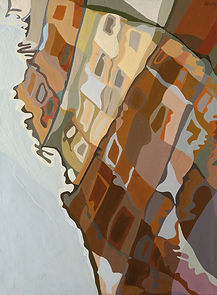
Translating oneself, 2024
oil on canvas, 90×70 cm

Maroon, 2024
oil on canvas, 90x90 cm

Flow, 2024
oil on canvas, 50×20 cm

Flakes, 2025
oil on canvas, 130×80 cm

Shallow water, 2025
oil on canvas, 100×20 cm

Nightfall, 2025
oil on canvas, 40×40 cm

Upside down, 2024
oil on canvas, 40×20 cm

Nocturnal, 2024
oil on canvas, 30x30 cm

Window sills, 2024
oil on canvas, 40×100 cm

Reverberation, 2025
oil on canvas, 60x70 cm
2024
5+1 Artists group show
Arianna Sartori Art Gallery

Mantua


Hi Adriana! I thank you from the bottom of my heart for sending me to the exhibition of your paintings: very delicate works that describe your sensitivity; curious about the reality of the things you see and intimately led to emotional transfiguration, like a daydream.
The theme of waters and lakes, the secrets of the invisible underwater that shines through the ripples of the broad brush strokes of color now clear now dense give visible form to the silence in which you normally hold your intimate personality. Like the soft colors and gently arranged among themselves are a mirror of the respect you always maintain towards the people you meet.
Very delicate works of visual poetry that from the detailed observation of visible truth fade into the subjective reading of the emotions they arouse.
Matteo Molinari
Scholar of Cinema History and Criticism,
Mantua
Now start destroying the image because everything is possible but nothing is real.
The universe is silence and darkness. We are the ones who light it with our eyes and ears.
Everything is totally abstract!
Andrea Gardini
Plastic artist
Mantua
Hi Adriana. We liked the exhbition a lot!🌈🤍🤩
It was all beautiful, your artworks were very "mantuan".
[...] Congratulations again, and a warm hug.
In November 2024, I was invited by Adriana to the Galleria Sartori, where the exhibition of 6 independent artists took place. As soon as you enter the gallery, you are welcomed by a relaxing atmosphere: the walls are adorned with artworks that seem to dance under the spotlights.
Adriana prefers oil painting on canvas. She loves pastel colors and you are immediately transported to a watery dimension, given her predilection for reflections and water games.
The soft shades of blue, mint green and coral envelop you and immediately convey a feeling of peace. You can't help but notice how each painting tells a story linked to water: boats, colored trees, light waves that conceal reflections that almost seem to be able to move on the canvas.
One of the works that struck me the most is "In riva", a large painting that portrays a series of floating trees. The pastel shades of green and blue are so harmonious that it seems you can touch them. It is incredible how Adriana manages to capture the lightness and grace of these views. Every detail is taken care of with precision, but without ever being excessive; it is as if each brush stroke had been chosen to evoke an emotion.
My favorite, and most lively, remains “Belfiore”, an evocative painting of a variety of plants hosted in the city park.
In short, Adriana’s exhibition is a real gem for art for nature lovers. If you find yourself in Mantua, do not miss the opportunity to let yourself be transported into this aquatic universe. You will come out more serene and inspired!
Stefano Zanuccoli
Computer technology expert
Mantua
Our lakes


Al Büs dal Gat, 2024
oil on canvas, 90x90 cm

On the shore, 2024
oil on canvas 80x100 cm

Belfiore, 2024
oil on canvas, 70x110 cm
One girl in every port
series

Rossella
2024 oil on canvas 30x60 cm

Anastasia
2024 oil on canvas 30x60 cm

Gaia
2024 oil on canvas 30x60 cm

Maddalena
2024 oil on canvas 30x60 cm

Eleonora
2024 oil on canvas 30x60 cm

Sofia
2024 oil on canvas 30x60 cm
anthological artworks
Paintings

Zoudine's painting technique
Serenella Minto
At the beginning of his artistic career, Zoudine laid out a geometric grid of orthogonal lines on the light base of the canvas, allowing it to show through in some areas as he continued to work with colors. A characteristic of his initial technique was precisely that of allowing the background tone to emerge between the layers of color, which contributed to the luminous vibration of the whole. His first step consisted of sketching the areas of greatest chromatic uniformity, then moving on to apply a first layer to define the outlines of the forms. Sometimes the subsequent colors were applied fresh on the underlying layer, or intentionally allowed to dry before proceeding. These initial layers were gradually overlaid with other colors, applied with broad, denser brushstrokes, as if composing a mosaic.
Over the years, this practice has evolved without ever betraying its original vocation: capturing the luminous vibration of colors. The artist's current palette reveals a thoughtful, almost emotional choice of colors: ultramarine and cobalt blue coexist alongside cadmium yellow, while Veronese and emerald greens appear as discreet presences, called upon only when necessary. The reds—vermillion and alizarin crimson—form the warm heart of the composition, later enriched by the introduction of cobalt violet.

Zoudine, however, is never satisfied with color as it is. She rarely uses pure pigment: she prefers to let them interact, contaminating them, or lightening them with white to achieve the luminosity that permeates her works like a breath. One of her most recurring combinations, almost a workshop secret, is the blend of alizarin crimson and phthalo green: an unexpected pairing that allows her to create all the darkest shades, from deep chromatic black to the densest, earthiest browns.
Furthermore, in keeping with a well-established workshop tradition, the artist carefully prepares the mixes on a perfectly clean palette, ensuring maximum chromatic precision. Only after this preparatory phase is the color applied to the canvas, ready to be integrated into the composition.
For each element to be painted, Zoudine uses different brushes and a wide variety of application methods: hard, bold strokes for larger areas, horizontal strokes for reflections on the water, circular movements for moving reflections, and smoother strokes for geometric shapes. He also uses a palette knife to achieve different levels of brightness and thin brushes to draw contour lines—if necessary—between the different areas of color.

Allez, allez!, 2009
oil on canvas,130x60 cm

Ostinato, 2009
oil on canvas,30x85 cm

Russia, 2007
oil on canvas, 70x100 cm

Mondadori Palace, 2007
oil on canvas,160x100 cm

60º N Canal in St. Petersburg, 2006
oil on canvas, 50x80 cm

The moon, the knight and the rocinante, 1997
oil on canvas, 200x80 cm

Icon, 2001
oil on canvas, 150x80 cm

Swamp, 2011
oil on canvas,100x90 cm

The banks, 2008
oil on canvas, 75x115 cm

Swimming pool, 2009
oil on canvas, 70x90 cm

Pavlovsky, 2006
oil on canvas, triptych 200x290 cm


Peter Pad, 2006
oil on canvas, 154x30 cm

Woods, 2001
oil on canvas, 80x60 cm

Thunderstorm, 2001
oil on canvas, 100x90 cm

Upside-down sky, 2004
oil on canvas, 60x100 cm

The lake, 2006
oil on canvas 60x80 cm

Flooded land, 2001
oil on canvas, 90x100 cm

Puerto Madero, 1995
oil on canvas, 100x100 cm
engravings

Art and life:
The compositional system, the technique and the color
Serenella Minto
It can be confirmed that the artists do not see "differently", but "better." They do not express with emphasis or obfuscation what they perceive, but through a language that’s precise, modern, and civil.
The figurative thinking of Zoudine can be condensed into a few constant features: the unmistakable beauty of the drawing; the extreme elegance of the composition; the constant presence — sometimes evident, more often concealed — of a dualism between the sensuality of the line and its dissolution into the chromatic surface.
In the mature phase of her investigations, the artist abandons her interest in the linear sinuosity of Art Nouveau, drawn by the free luminosity of the late Impressionists, the chromatic force of Matisse, and, even more, the communicative intensity of the Expressionists. But she feels the need to find a personal path which she discovers by combining her passion for photography with the precision of geometric design.

Il percorso artistico
La formazione di Adriana Zoudine affonda le sue radici nello studio precoce della pittura e della storia dell’arte, un terreno fertile che le permette di sviluppare fin da giovane una sensibilità visiva autonoma.
In Brasile entra in dialogo con l’opera di maestri come Candido Portinari, Emiliano Di Cavalcanti e Lasar Segall: figure che le offrono i primi riferimenti all’Espressionismo e al Modernismo. In seguito, ad affascinare la giovane artista brasiliana sarà una piccola composizione eseguita nel 1888 da Paul Sérusier — seguendo i suggerimenti di Paul Gauguin — considerata l’emblema dei Nabis (da cui il nome di Talismano), con immagini fortemente sintetizzate e colori intensi, privi di riferimenti naturalistici ma ricchi di valenze simboliche. L’opera fu realizzata da Sérusier come esercizio, ma divenne il manifesto di una nuova visione artistica: non imitare la natura, ma trasmettere emozioni attraverso il colore e la forma. La riproduzione dell’opera accompagnerà Adriana Zoudine nei suoi spostamenti in tutto il mondo.
Ma, in seguito, sarà soprattutto l’incontro con le opere di J. M. W. Turner e la sua poetica sulla smaterializzazione dell’immagine a orientarla verso l’orizzonte europeo.
Gli anni universitari la vedono impegnata in ricerche sul Funzionalismo, tra architettura e disegno industriale. Da queste indagini nasce l’interesse per il razionalismo formale e per le geometrie urbanistiche delle città moderne osservate dall’alto: tessiture che si imprimono nella sua memoria visiva e che diverranno tracce permanenti nella sua produzione. In esse Zoudine riconosce un ponte tra l’energia del mondo naturale e la ricerca di essenzialità nella rappresentazione pittorica.
Il passo successivo la conduce verso l’arte astratta del Novecento. Kandinskij e Klee diventano compagni di viaggio ideali, aprendo la strada a una riflessione concettuale che intreccia paesaggio e colore. È qui che prende forma la sua sintesi cromatica e formale, un linguaggio che si muove tra evocazione e astrazione, tra memoria e visione.
La sua ricerca evolve così dalla figurazione verso territori prossimi all’astrazione, mantenendo talvolta una leggibilità essenziale: un equilibrio sottile che invita lo spettatore a soffermarsi davanti ai quadri e a lasciarsi attraversare dai contrasti e dalle vibrazioni cromatiche, in un dialogo continuo tra emozione e forma.

Nocturnal-urbe
43x54 cm

Gate
26x32 cm

Gate
26x32 cm

Gate
26x32 cm

Pause
29x25 cm

Streetcar
15x10 cm

The foreign kings
12x16 cm

Fire and ash's angel
10x12 cm

All Star
42x32 cm

Nocturnal-nature
43x54 cm

Woods
23x13 cm

In the woods
25x14 cm

Swamp
20x32 cm

Rapids
13x57 cm

Nighttime
23x24 cm

Grapewine
20x10,5 cm

Grapewine
20x10,5 cm

Inca town
25x15 cm

Piazza Vecchia
35x19,5 cm

All Star
42x32 cm
fused glass

Themes and inspirations on water, light and memory
Serenella Minto
His interest in the reflections of light on water, in natural and urban landscapes, is constant: fleeting images, captured in the instant of their appearance. Central to his work is his connection with aquatic landscapes, where water becomes a structuring element of the visual space. Mantua emerges as a true "place of inspiration": the architecture reflected in the canals and the expanse of its watery horizons offer the artist an inexhaustible source of inspiration.
Adriana Zoudine's painting, despite her bold experiments—numerous and courageous—reactivates values that we might define as traditional: from the paintings of J.M.W. Turner, a visionary of English Romanticism, in which water dissolves in light, becoming a luminous organism; to Monet, the undisputed master of reflections on water; to Joaquín Sorolla, an interpreter of Mediterranean light; to J. McNeill Whistler, who in his Nocturnes transforms water into atmospheric architecture; to Gustav Klimt, who in his lake landscapes restores the decorative vibration of nature; and to Paul Klee, who with his abstract sensibility translates the aquatic element into rhythm and chromatic memory.

All these artists form a common thread running through art between the late 19th and 20th centuries, which Zoudine reworks in a personal way, transforming water into a metaphor for time and memory. From this perspective, his work is nourished by an abiding interest in nature and a search for balance between emotional sensitivity and spirit: far removed from intellectual complications and philosophical doubts about the representability of reality, but fulfilled by a disciplined interpretation of the present and a measure of happiness filled by the enjoyment of the painting.

Park in San Petersburg
130x100 cm

The gate 1 - Sunrise, 2007
26x26 cm

The gate 2 - In broad daylight, 2007
26x26 cm

The gate 3 - Sunset, 2007
27x27 cm

The gate 4 - Evening, 2007
25x25 cm

untitled, 2008
40x30 cm

untitled, 2008
40x30 cm

Fall, 2006
75x57 cm

Port, 2007
118x40 cm

Facade, 2005
41x35 cm

untitled, 2003
25x15 cm

untitled, 2004
25x15 cm

untited, 2008
30x40 cm
Contact me
Adriana Zoudine
Mantua (Italy)
Born in São Paulo, Brazil in 1961, a descendant of Russian and Italian immigrants, I am an Italian citizen.
Having graduated in mechanical engineering in 1984, I have traveled extensively, living for a year in San Francisco, followed by four years in Buenos Aires, and having come to Italy numerous times.
Even though I worked as an engineer almost non-stop, I never left the artistic profession.
Her career as a visual artist began in childhood with painting and a self-taught study of art history, followed by workshops and exhibitions.
During my artistic career I have dedicated myself mainly to oil painting on canvas.
About me
.jpeg)
In 1999 I graduated with a degree in art education.
At university I learned the technique of xylography, and later painting on fused glass, both techniques for which I also have a great passion.
Little by little I moved from pure figuration to an almost abstract configuration where the forms are still distinguishable.
In both natural landscapes and urban scenes, I have always been particularly interested in the reflection of images and light on water. They are fleeting images captured on the fly.
You can understand, therefore, the great attraction I have for water landscapes, whether natural or urban: nature and cities where water plays the role of a fundamental character.